Physical Interfaces for Robot Learning
Description
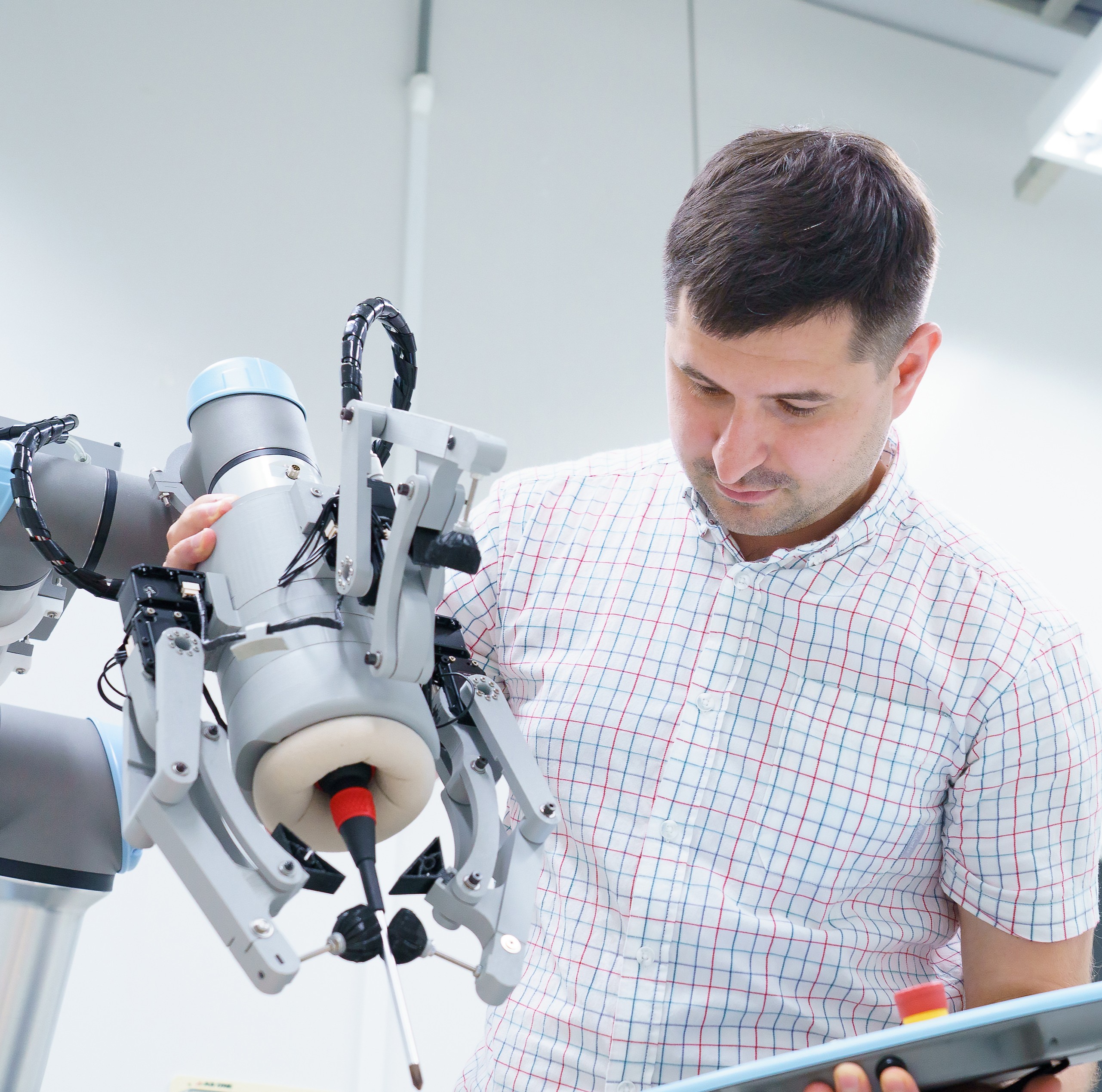
Recent advances in imitation learning, reinforcement learning, and multimodal foundation models are rapidly expanding the range of robotic tasks that can be learned from human demonstrations and interaction data. However, the performance of these methods depends fundamentally on the physical interface through which a robot interacts with its environment. Conventional rigid end-effectors and standard sensing architectures are often designed primarily for motion execution rather than for generating rich, task-relevant interaction data. My research addresses this limitation through the development of physical interfaces for robot learning, in which mechanical design, adaptive structures, multimodal sensing, teleoperation, and robot-learning algorithms are intentionally co-designed. Rather than treating the robot’s physical interface simply as a mechanism for executing learned commands, I investigate how embodiment can actively contribute to data acquisition, perception, skill learning, and generalization.
Funding
The project partially funded by AIST, JSPS, New Energy and Industrial Technology Development Organization (NEDO), and FRONTia.
Colaboration
- National Institute of Advanced Industrial Science and Technology (Japan).
- Department of Systems Innovation, Osaka University (Japan).
- Waseda University (Japan).
Projects
- Tensor-Interpreted Magnetic Tactile Sensing for Adaptive Sectional Fin-Ray Fingers
- SUGI: Smart Universal Grasping Interface
Publications
- J. Carreon, F. Erich, R. Mykhailyshyn, T. Motoda, R. Hanai, Y. Domae, A Flexible Field-Based Policy Learning Framework for Diverse Robotic Systems and Sensors. IEEE/SICE International Symposium on System Integration (SII) 2026, 1192-1197.
- T. Motoda, M. Murooka, S. Keisuke, H. Oh, R. Nakajo, S. Miwa, R. Mykhailyshyn, H. Duarte, Y. Domae, Self-Supervised Anchoring of Fingertip Sensing to Proprioception and Proactive Actions for Robot Imitation Learning. IEEE International Conference on Robotics & Automation (ICRA) 2027, Under review.
- S. Iwakata, T. Motoda, R. Yamada, K. Makihara, R. Nakajo, K. Tanaka, M. Murooka, R. Mykhailyshyn, H. Kataoka, S. Morishima, Y. Domae, Improving Imitation Learning Efficiency for Manipulation through Geometric Prior Pretraining, IEEE/SICE International Symposium on System Integration (SII) 2027, Under review.
- Y. Delgado, J. Carreon, F. Erich, R. Mykhailyshyn, T. Motoda, K. Makihara, Y. Domae, Peg-in-Bench: A Modular Benchmark for High-Precision Robotic Insertion, IEEE/SICE International Symposium on System Integration (SII) 2027, Under review.
- H. Duarte, T. Motoda, Y. Domae, R. Mykhailyshyn, Beyond Midpoint Indentation: Spatial Contact-Wrench Mapping of Fin Ray Fingers with Lie-Group-Based Sensor Fusion. IEEE International Conference on Robotics & Automation (ICRA) 2027, Under review.
- K. Shirai, T. Motoda, H. Oh, R. Nakajo, R. Mykhailyshyn, R. Hanai, S. Miwa, Y. Domae, Stochastic Action Sequence Tokenization for Data-Efficient Training of Autoregressive Vision-Language-Action Models. IEEE International Conference on Robotics & Automation (ICRA) 2027, Under review.
- R. Putra, F. Erich, S. Keisuke, M. Abdulah, R. Mykhailyshyn, T. Motoda, K. Makihara, T. Suzumura, Y. Domae, WGF-VQ: Wasserstein Gradient Flow for Vector Quantization in Robot Learning. IEEE International Conference on Robotics & Automation (ICRA) 2027, Under review.